Wondering why a social enterprise bike shop feels different from a regular shop? You are buying from a business that sells bikes and repairs like any other but puts its profit into a social mission, such as training or low-cost bikes.
This guide sits within the wider topic of social enterprise cycling, which looks at how bikes are used to reach social goals.
| Item | Value |
|---|---|
| Bikes passing through Working Bikes’ Chicago building | Roughly 12,000 per year |
| Typical price of refurbished bikes at Working Bikes | Around $200 to $300 |
| Lowest-priced children’s bikes at Working Bikes | As cheap as $20 |
| Community Cycles of California training program length | Six months, 40 hours per week |
| Trainee pay in that program | $20+ per hour |
| Grant behind that training program | $300,000 |
These figures come from a Freethink report on Working Bikes and a Jails to Jobs article on Community Cycles. Figures can change, so check the sources before you rely on them.
What makes a social enterprise bike shop different?
The trade looks familiar: bikes, parts and repairs. The difference is purpose, because in a social enterprise the sales exist to pay for a mission rather than only to produce profit for owners.
Bikes Not Bombs, a non-profit founded in 1984 and based in Boston, says it uses the bicycle as a vehicle for social change. Its about page describes the goal as economic mobility for Black and other marginalized people in Boston and the Global South.
A Daily Hive profile from November 2021 described Our Community Bikes in Vancouver as a non-profit social enterprise. It said the shop was created to remove used bikes from the waste stream and make bikes and repair facilities available at prices accessible to people facing financial barriers. The same profile reported that 40% of donated bikes go to people facing financial barriers, while profits fund community programming.
Put together, the examples point to a few common differences:
- Stock leans on donated bikes that are refurbished rather than only new bicycles.
- Prices and free-bike schemes aim to reach people who face financial barriers.
- Profit is routed into programs such as training, youth clubs and repair clinics.
- Volunteers and trainees are part of how the shop runs.
Where the profit goes
In a regular shop, profit is the end point. In these shops it is the funding source, and several of them say the retail floor carries the rest of the organisation.
Freethink reported in October 2019 that income from the Working Bikes store on Chicago’s West Side provides the vast majority of its operating budget. The same Freethink report said roughly 12,000 bikes a year pass through the building, with about 70,000 donated in Chicago and overseas to date.
The Community Cycling Center in Portland explained the logic in a 2013 blog post. Its shop stabilises staffing, secures wholesale pricing for program parts and supplies, and provides space for volunteers and bike production, while shop sales proceeds round out program funding.
Community Cycles of California follows a similar pattern. A Jails to Jobs article from May 2025 said its bike shop is self-sufficient and helps support the organisation’s programs, and that it also earns money fixing bikes at events where cities pay for repairs.
How the bikes and repairs compare
A donated bike is only useful if it is safe, so checks matter more than the label on the shop. Community Cycles of California says on its Idealist listing that more than 60 tasks and check points are carried out on each bike it refurbishes, whether the bike is sold in the shop or goes to a client.
At Working Bikes, volunteer work on bikes earmarked for donation is checked by professional mechanics to ensure safety. Recipients are matched with a suitable bike and also receive locks, lights and a helmet, according to the Freethink report.
Prices tend to be lower than for new bikes. The same report said refurbished bikes at the Working Bikes store are mostly priced around $200 to $300, with children’s bikes as cheap as $20.
Some shops mix both worlds. Bikes Not Bombs lists new bikes and refurbished bikes side by side in its online shop, with purchases supporting its mission.
Whichever shop you choose, a basic bike maintenance checklist is a sensible way to review the brakes, tyres and chain before you ride a bike home.
Training, volunteering and shared workspace
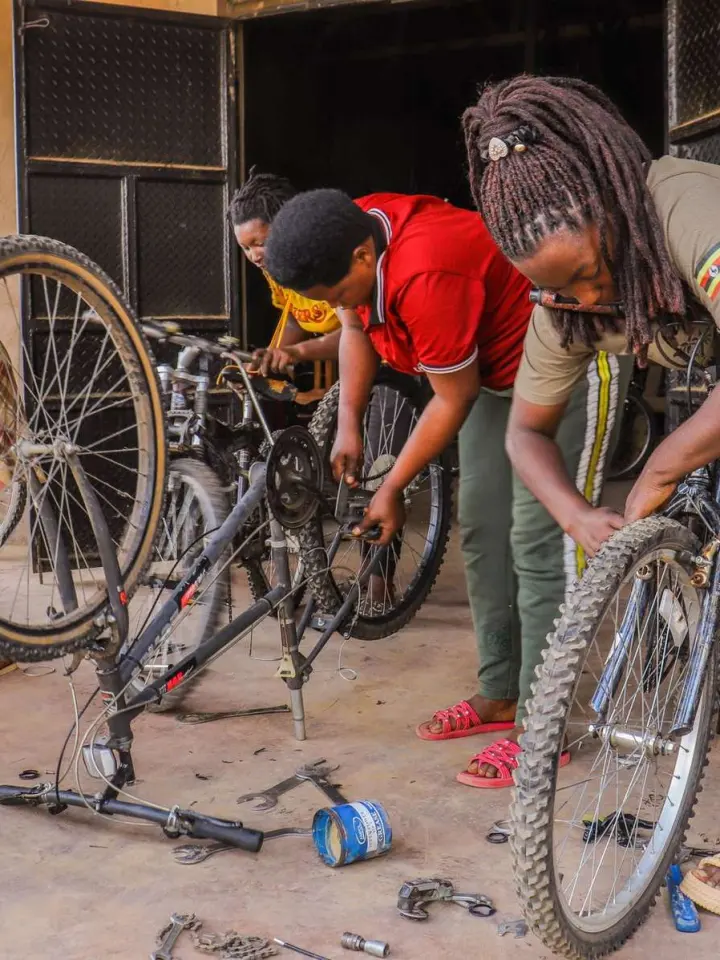
The clearest contrast with a regular shop is that the workshop doubles as a classroom. Community Cycles of California ran a Bike Maintenance and Retail Program that lasted six months at 40 hours per week and was funded with a $300,000 grant. According to Jails to Jobs, it paid participants $20+ per hour; 10 people started and seven finished.
The founder told Jails to Jobs he expects less than 25% of graduates to work in the bike business. The shop is used as the classroom for transferable business skills, which shows the bike is the tool rather than the only goal.
Demand for this kind of work exists. In the Community Cycling Center’s 2013 post, 33% of young people surveyed at a needs assessment were interested in jobs in bicycle repair and maintenance.
Volunteer-led shops also open their tools to the public. The Recyclery Collective in Chicago runs an Open Shop where you use its tools to fix your own bike with instruction from its mechanics, and its Idealist listing says major decisions are made by a collective that meets twice a month. A community bike workshop works on a similar open-shop idea.
Inclusion is part of the design too. Working Bikes reserves Thursday night sessions for women, trans and femme volunteers, and its community engagement manager told Freethink that bike shops are hostile environments for lots of people.
How can you tell if a shop is a social enterprise?
The label is not protected, so look for evidence rather than a slogan. These steps work for any shop near you:
- Read the about page for a stated social purpose, such as employment, access or sustainability.
- Ask where the profit goes and whether it funds named programs.
- Look at the stock: donated and refurbished bikes are a common sign.
- Check for programs such as training, youth clubs, open repair time or free-bike schemes.
- Look for published reports or news coverage that describe the funding.
Shops may call themselves non-profit, community or social enterprise, and the terms overlap. Judge each shop by what it publishes about its money and its programs.
Frequently asked questions
Is a social enterprise bike shop always a non-profit?
Show answer
Not by definition, but the examples in this guide are non-profits. The Daily Hive profile calls Our Community Bikes a non-profit social enterprise, so check how any shop describes its own structure.
Are refurbished bikes from these shops safe to ride?
Show answer
Shops describe safety checks, but the depth varies. Community Cycles of California lists more than 60 tasks and check points per bike on Idealist, and Freethink reported that Working Bikes has professional mechanics check volunteer work. Ask any shop what it checks before you buy.
Can you buy new bikes at a social enterprise shop?
Show answer
Sometimes. Bikes Not Bombs lists both new and refurbished bikes in its online shop, so the model is not limited to used stock.
Does my purchase really fund the mission?
Show answer
The shops say so. The Recyclery Collective states on Idealist that a purchase keeps a used bike running and funds its educational programs, and Bikes Not Bombs says on its about page that a purchase supports its mission.